Bananas
You may
think that you already know a lot about Pisang. But did you know all about
this facts? I didn’t!
Bananas aren't grown on trees. They're part of the lily family, a cousin of
the orchid, nothing but a very yellow and plump member of the herb family.
With stalks 25 feet high, they're the largest plant on earth without a woody
stem. They are thought to have originated in Malaysia but spread throughout
Asia, India and Africa before Columbus discovered America. Unknown in that
hemisphere before then, bananas came to the New World in 1516 when Spanish
missionary Friar Tomas de Berlanga brought over the first root stocks. The
word banana is African, though, a word carried to the New World by
Portuguese slave traders. In Alexander the Great's time, bananas were called
“pala” in Athens.
Bananas require at least 75 inches of water annually, a
temperature of 24 C and fertile, well-drained soil. Although the banana
plant grows as much as 30 feet tall, botanically it is an herb! There are
groups of the cultivated bananas: those are eaten raw, those, which are
cooked before eating, and those with fruits, which can be either cooked or
eaten raw. The fruiting stalk of the banana consists of many clusters called
hands. Each female flower of the basal end of the stem develops into a fruit
– the “finger”. Male flowers are produced toward the apex of the stem.
North America got its first taste of
the tropical fruit in 1876 at the Philadelphia Centennial Exhibition. Each
banana was wrapped in foil and sold for 10 cents. Today the average American
consumes about 25 pounds a year of the mellow yellow, every one of them
imported from Latin America, where the climate favors the warmth-loving
plants. Rich in potassium, vitamins B, A and C, bananas are not only popular
but considered healthful by most of us. In fact, there are funny numbers
reported in the New England Journal of Medicine that a banana can cut the
risk of death from strokes by as much as 40 percent in certain cases.
When is a
Banana Ripe?
Most of us know that the color of a banana's skin indicates its degree of
ripeness. But there's ripeness and then there's ripeness. Here's a precise
guide to using bananas.
 |
Green -- unripened bananas, used in
soups and stews. |
|
Yellow with green tips -- partially
ripe, used for broiling, baking or frying. |
|
All Yellow -- ripe, eaten raw or in
waffles, puddings, cakes or pies. |
|
Yellow with brown freckles --
full-ripe, raw or in salad, fruit cup or other dishes calling for uncooked
fruit. |
|
All Brown -- over ripe, if flesh is
firm, still in prime eating condition. |
|
Blackened areas -- bruised fruit and
should be avoided. |
Bananas in Indonesia
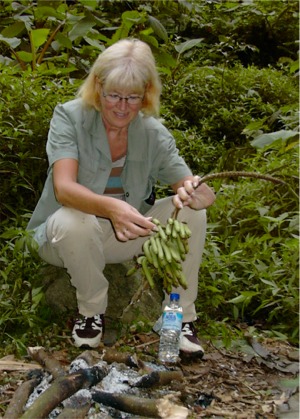
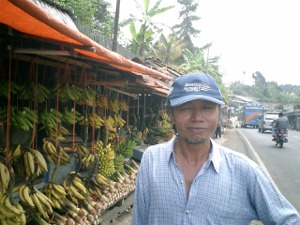
Indonesia is full of what are called in the trade “ back
yards bananas” meaning homegrown verities of many and varied types. In
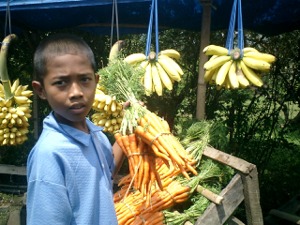
Indonesia, bananas come in many different sizes and shapes. You will find
that some are no larger than your thumb. This variety is
called 'biu susu' or 'milk banana'. Another kind called the 'shrimp banana'
has a red- colored peel. An interesting type is the 'stone banana' or 'biu
batu' as this has many hard seeds inside!
Indonesians put the banana tree to good
use in addition to enjoying the fruit. Banana stalks are used to stir a
cauldron full of dye, the banana flowers are used raw in salad, and banana
leaves are used to wrap food.
About Plantains
The plantain (or platen’s) is a banana, musa paradisiaca, which is
eaten cooked rather than raw. Plantains are eaten in most tropical
countries of the world. The largest exporters of bananas are the northern
portions of South America as well as Central America.
How To
Select a Plantain?
Plantains can be prepared at any stage of ripeness. Make sure to
pick a recipe appropriate for the fruit you have on hand.
|
Green: When the plantain is green it is quite starchy
and the flavor is much like a potato. The green fruit can be fried or
boiled. |
|
Yellow: When the plantains yellow the sugars begin
to develop and impart a slight sweetness to the fruit. At this stage the
fruit may show a few freckles of black. |
|
Black: The plantain is at it's sweetest once it turns
black. Normally you would want to use black plantains for dessert or any
recipe where a sweet taste is desirable. You may purchase yellow
plantains and store them in a paper bag until then ripen and turn black.
|
Nutrition
The fruit is primarily
carbohydrate, approximately 40 grams per 1/2 banana and about 180 calories.
Like the common yellow banana, the fruit is very high in potassium
approximately 500 milligrams per serving. The plantain is normally eaten as
a starchy staple food. It can be boiled, baked, or fried and served as a
vegetable or made into a sweet dessert, depending on the degree of ripeness
of the fruit.
Raw, unripened fruit can be irritating
to your digestive system. Imperfectly ripened bananas are composed of
starch; but as the natural ripening proceeds, the saccharine material is
converted into dextrine and glucose. Cook the starchy, unripened fruit as
you would use a potato, or let them ripen at room temperature to sweeten.
When they are the color you need, bananas can be stored in the refrigerator.
The skins may turn dark, but the pulp will stay at the desired ripeness.
|
 |
More Fruit
Papayas also come in varying sizes and
shapes. Some are like elongated melons, filled with tiny black seeds. The
flesh may range from yellow to a deep red. The outer skin is green in color.
Indonesians eat unripe papayas as a boiled vegetable. Balinese often wrap
meat in papaya leaves to tenderize
it. |
|
|
