Javanese weddings


Traditional Javanese Weddings

Love and marriage in Indonesia

Javanese ceremonies

Traditional Javanese Weddings

Count yourself fortunate if you've had the opportunity to attend an Indonesian wedding. The fascinating wedding ceremonies and festivities give expatriates a unique opportunity to gain insight into Indonesian culture and social mores.

Given the broad diversity of ethnic groups in Indonesia, it stands to reason that wedding customs will reflect this diversity. Each ethnic group has different wedding dress and different marriage ceremonies and customs. Within ethnic groups, those of different religious backgrounds will have different practices as well.

 As a expatriate living in Indonesia you may on occasion receive a wedding invitation. You may not know how to act, what to bring or what your role as a guest in the wedding should be. We'd like to outline what happens at most weddings in Indonesia to help prepare you. If in doubt, consult colleagues or friends that you know have been invited or ask colleagues or your secretary to determine what appropriate dress and gift would be.  

Attendance is Important

One of the most important concepts at Indonesian weddings seems to be 'the more the merrier'. Literally every relative, acquaintance, colleague or business partner could be invited to the wedding. Joining a group of others that are invited, even if you did not receive an invitation personally addressed to you, is also okay (as long as it's not a sit down dinner -in which case the limit is clearly stated on the invitation).  

Indonesians are truly honored by your attendance at a wedding. Attending shows that you care, that you respect the people involved and your relationship with them, that you honor the family and want to show your support of the newlyweds. Don't question the intent of colleagues or subordinates who, upon short acquaintance, invite you to their daughter's or son's wedding. They really do want you to come!  

On the other hand, not responding to the invitation, or not attending can cause a significant insult and slight to the giver, which can cause problems in your relationship in the future.

The Invitation

Wedding invitations in Jakarta and other urban centers can be very extravagant. The date on the outside of the envelope is very practical if you receive many wedding invitations. In rural areas, the invitation is done via visits from the family to neighbors and friends.

 The sincere welcome extended to guests is noted on the invitation with wording such as "Merupakan suatu kehormatan & kebahagiaan bagi kami apabila Bapak/Ibu/Saudara/i berkenan hadir untuk memberikan doa restu kepada kedua mempelai" or "Tiada yang dapat kami ungkapkan selain ucapan terima kasih dari hati yang tulus atas kehairan serta pemberian do. a restu Bapak/Ibu/Saudara/i kepada putra-putri kami". Both of these phrases mean that you do the family great honor by attending and extending blessings upon the bride and groom.

 On the invitation will be noted the date, time and place for the Akad Nikah, which is the actual wedding

 The Gift

In the past (as in the mid-90s before the economic crisis), the grand, glorious, conspicuously extravagant weddings in Jakarta were gifted with large floral displays which were placed outside the reception hall. Or, wedding guests brought a wide variety of household goods as gifts. In a large wedding, to which thousands of people may be invited, there would be many duplications of gifts. It would not be unusual at avery large wedding for the wedding couple to receive, for example, 15 blenders, 20 mixers, 10 toasters, 25 rice cookers, 5 refrigerators, 3 cars, etc.  

Therefore, a relatively new practice arose in the mid-90s whereby the wedding couple asks the attendees not to bring gifts or floral displays by the inclusion of additional wording on the invitation "Dengan tidak mengurangi rasa hormat dan terima kasih, akan lebih bermanfaat seandainya ungkapan kasih sayang yang mungkin akan diberikan kepada kami tidak berupa cendera mata atau karangan bunga"  or "Dengan tidak mengurangi rasa hormat kami, akan sangat berterima kasih apabila tanda kasih yang akan diberikan tidak berupa cenderamata atau karangan bunga". This translates as, Without belittling your generosity, we'd appreciate it if you didn't give us flowers or a gift.  

This is a nice way of asking for money instead of gifts. At the reception desk there will be a beautifully decorated box with a slit in the top into which you can insert an envelope with money. If you choose to give money and are uncertain of an appropriate amount to give, ask your secretary or Indonesian colleagues for their suggestions. Sometimes the hostesses will number your envelope as well as next to your signature in the guest book, so that the bride and groom know how much money you gave.  

Thank You

Don't expect a thank you note after the wedding for your gift. In many weddings attendees are given a small token upon their arrival, a fan, key chain or other item. Attached to this item will be a thank you for your attendance.  

Wedding Receptions

The difference in the income level of the individuals will, needless to say, have a great bearing on the extent of the wedding celebrations. Weddings in Jakarta range from simple meals in the family home, to small receptions in community centers to grand extravagant affairs in the Jakarta Convention Center or 5-star hotel ballrooms.  

At most wedding receptions, the guests arrive, sign the guest book, accept their thank you token, deposit their gift and enter the reception hall.  

The path into the reception hall will be flanked left and right with members of the extended families, often dressed in similar traditional dress. A smile and nod to some of these people would be appropriate. Following the family members may be young men and women holding a chain of flowers. This is called the pagar ayu or 'fence of beauty'.  

After the speeches, the guests are invited to come to the stage and shake the hands of the bride and groom and their parents. Depending on the number of guests this receiving line can go on for hours. Traditional music may beplayed throughout the reception.  

After going through the receiving line, the guests are invited to eat. The feast can be quite extensive and is a good opportunity to try cuisine from different regions. It could be as simple as nasi goreng or bakmi goreng, ikan asem-manis to the more elaborate where there will be food stalls with sushi, tempura, kambing guling, dim sum, beef Wellington and other western dishes. Once the speeches are complete, it is also acceptable to eat first and then join the receiving line after your meal if the line is quite long.  

When should you arrive and how long should you stay?

 While some attendees will arrive early, the timing of your arrival should be determined by whether or not you want to see the procession and hear the speeches. If you do want to, you should come on time. If you. d rather miss the grand entrance and speeches, you can come 30-60 minutes after the time noted on the invitation. Then you can enter immediately into the reception hall, shake hands and proceed to the buffet tables.  

The length of time you spend at the reception is entirely up to you. Many Indonesians may only stay 15-30 minutes to eat a small snack after shaking hands, especially if they have another invitation to attend that night. Some people can even have up to 5 or 6 wedding invitations for one evening! If you are enjoying the splendor and the food, know lots of the attendees and enjoy the chance to chat, stick around and enjoy yourself. If, on the other hand, you don. t know anyone who is there, it is acceptable to shake hands, eat and leave promptly (SMP-sudah makan pulang-when you've finished eating you can go home :). In a small wedding you will shake hands again before leaving.  

Don't expect that alcohol will be served at the wedding reception or that there would be dancing, this is highly unlikely. Likewise, coming to a wedding after drinking would be considered very rude. Even if the groom is your drinking buddy, weddings are not an appropriate venue in which to be drunk.  

Source: Site for Expatries Jakarta/Indonesia

Love and Marriage in Indonesia

Indonesia has many diverse cultures. This enormous variety in cultures has a great impact on marriage ceremonies. Every wedding in Indonesia has a different ceremony, each of them influenced by the cultures of the families involved. Every ceremony is a step in the creation of a new bound between two families.  

The parents of the man (would-be-bridegroom) send an envoy to the parents of the woman (would-be-bride), proposing that their son is willing to marry their daughter. Nowadays, for practical reasons, the parents of both sides can talk directly. The parents of the couple have to approve the marriage. 
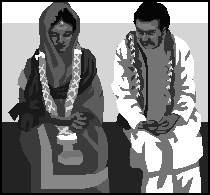
She takes care of the make-up and dressing of the bride and bridegroom, the different kind of offerings, the different kind of ceremonies during the event, etc. Usually, she can also lend a complete wedding dress, ornaments and equipment necessary for a wedding party.

 The wedding party should be prepared carefully as it contains many things to do, no matter which ceremony is chosen. A small wedding committee of close relatives and friends from both families is set up. The size depends on how big the party has to be and on how many guests will be invited (300, 500, 1000 or more guests). In fact, a wedding ceremony is a big show, reflecting the families' standing in the society. 

This committee has to organize the whole wedding: the wedding protocol, food and beverages, gamelan music and dance, decoration of the reception hall, master of ceremony, witnesses for Ijab, welcoming speech during the reception, transportation, communication, security, and so on. The most important thing to prepare is no doubt the execution of Ijab (the religious and civil registration which legalizes the couple as legitimate husband and wife).

Usually one day before the wedding party, the gate of the house of the bride's parents is decorated with Tarub (plant decorations), which consists of different Tuwuhan (plants and leaves). 

Two banana trees with stem of ripe bananas meaning: The husband will be a good leader of his family. As banana trees grow easily everywhere, the couple can also live well and happy everywhere, in good terms with the environment. 

A pair of Kembar Mayang is a kind of bouquet made of different kind of leaves (mainly coconut leaves stuck into a banana trunk). It is a very beautiful decoration with a broad symbolic meaning: 

It has a mountain like shape: A mountain is high and big, symbolizing a man should have a lot of knowledge, experience and patience.

· Keris (kris, double-bladed dagger): The couple should be careful in life.

· Whips: The couple should be always optimistic with the desire to have a good life.

· Umbrellas: The couple must protect their family.

· Grasshoppers: The couple should be energetic, quick in thinking and making decisions in order to keep the family safe.

· Birds: The couple should have a high life-motivation.

· Beringin (banyan tree) leaves: The couple should always protect the family and other human beings.

· Kruton leaves: The leaves protect them against evil spirits.

· Dadap srep leaves: The leaves could be used as a cold compress to lower fever, symbolising the couple should always have a clear mind and calmness to solve any problems (calm down the feeling and cool down the head).

· Dlingo Benglé herbs: These herbs cure infection and other diseases; they are used to get protection against evil spirits.

· Patra Manggala flowers: Used to beautify the bouquet.  Tebu Wulung (reddish sugar cane) meaning: The whole family comes together with a strong and a wise mind.

· A Cengkir Gading (half-ripe coconut) meaning: The couple loves each other and they always will take care of their loved ones.

 Different fresh leaves, such as of beringin (banyan tree), mojo-koro, alang-alang (tall, coarse grass), dadap srep (flowering trees) meaning: the couple should live in safety and protect the family.

On top of this, on the gate you will find bekletepe (ornaments made from plaited coconut leaves) to drive out evil spirits and as a sign that a wedding ceremony takes place in this house.  

Before the installation of Tarub and Bekletepe, a special Sajen (offering) must be made (for their souls should live in peace eternally) and to get protection against evil spirits. The Sajen should be placed in all the places where a ceremony takes place, such as in the bathroom, in the kitchen, under the gate, under the Tarub decoration, in the street nearby the house etc.

 Normally Sajen consists of:

· Tumpeng Robyong, a yellow rice cone with decoration.

· Tumpeng Gundul, a yellow rice cone with no decoration.

· Chicken, meat, tempe, bread and eggs.

· Seven kinds of porridge.

· Fresh fruit: bananas and other fruits.

· A peeled coconut and some coconut sugar.

· Sweet cookies made of glutinous rice.

· Tea and coffee.

· Cigar and pipe made of papaya leave.

· Jamu (herbal medicine).

· A lantern, which is lighted.

· Telon flowers (cananga, jasmine, magnolia) in bowl

Mona Mellbin

JAVANESE CEREMONIES: 

PANGGIH Ceremony:

The wonderful and mystical sound of Gamelan (a Javanese music instruments) accompanies a traditional sacred Panggih or Temu (means meeting) between a beautiful bride with her handsome bridegroom in front of a house decorated with 'Tarub' plant decoration.

 The bridegroom, accompanied by his close relatives (but not his parents who are not allowed to be present during the ritual), arrives at the house of the bride's parents and stops at the gate of the house.  

The bride, accompanied by two elderly women, walks out of the bridal room. Her parents and close relatives walk behind her. Preceding the bride are two young girls, Patah, holding a fan. Two elderly women or two young boys are carrying two Kembar Mayang (bouquet ornament), about one meter of height. One woman from the bridegroom's family walks forward and gives a Sanggan (a gift in the form of banana fruits and flowers put in a tray covered with banana leaves) to the mother of the bride, as a sign of appreciation to the hostess of the ceremonyDuring the Panggih ceremony, the Kembar Mayang are brought outside the house and thrown away in a crossroad nearby the house, depicting all evil spirits should not disturb the ceremony in the house and its surrounding area. For decoration, one pair has been put on the right and left side of the couple's wedding chair during the reception. Kembar Mayang is used only if the couple was unmarried before.  

BALANGAN SURUH Ceremony:

The bride is meeting the bridegroom. They approach each other. When they are about three meters from each other, they start throwing to each other seven small bundles of betel leaves with lime inside tied together with white yarn. They do it eagerly and happily, everyone is smiling happy. According to ancient belief, betel leaves have the power to chase away bad spirits. By throwing betel leaves to each other, it should be proved that they are really the genuine persons, not some ghost or another person who pretends to be the bride or the bridegroom. 

WIJI DADI Ceremony:

The bridegroom crashes a chicken egg with his right foot. The bride washes the bridegroom's foot using water mixed with several kinds of flowers. It depicts that the bridegroom is ready to become a responsible father and the bride should faithfully serve her husband.  

SINDUR BINAYANG Ceremony:

After the ritual of Wiji Dadi, the father of the bride leads the couple to the wedding chair, the mother of the bride covers the couple's shoulders with Sindur. Symbolising the father shows the way. 

TIMBANG Ceremony:

Both the bride and the bridegroom are sitting on the bride's father's lap, while he says that they have the same weight, meaning that he loves them both equally.

MERTUI Ceremony:

The bride's parents pick up the parents of the bridegroom in front of the house. They walk together to the place of the ceremony. The mothers walk in front, the fathers behind. The parents of the bridegroom sit on the left side of the couple. The parents of the bride sit on the right side of the couple.

 SUNGKEMAN Ceremony:

While they kneel, the couple will ask for the blessing of their parents: first from the parents of the bride, then from the parents of the bridegroom. During the Sungkeman, the Pemaes takes out the keris from the bridegroom. After the ritual, the bridegroom wears again his keris.

 It should be noted that the couple's parents are wearing the same design of batik (Truntum), meaning the couple should always have enough fortune for a good living.

 They are also wearing Sindur as waist sash. The red drawing in the Sindur with its curved edges means that life is like a river running through the mountains. The parents are escorting the newlyweds to the real life so they can build a strong family.
